Acoustic Glazing: How Noise Reduction Glass Works
Acoustic glazing is glass designed and specified to reduce sound transmission through a window. Its performance depends on how mass, damping, pane asymmetry and cavity work together — and on the frame, seals and installation around it.
Important: a glazing Rw value is a laboratory, declared or calculated rating for the glazing construction. It is not a promise that a room will become quieter by the same number of decibels.
Technical review: Sebastian Paszek · Institute of Acoustics Certificate of Competence in Environmental Noise Measurement · Last reviewed 5 October 2026
WHAT IS ACOUSTIC GLAZING?
Acoustic glazing is not one special type of glass with one fixed performance level. It is a glazing construction engineered to reduce airborne sound by controlling the mass of the panes, damping within laminated glass, the relationship between pane thicknesses and the cavity between them.
A high-performing unit may use monolithic glass, acoustic laminated glass, asymmetric pane thicknesses and carefully selected cavities. The right build-up depends on the noise source and the window system into which the glass will be installed.
Thicker and heavier panes generally improve sound insulation, but mass alone does not determine performance.
Acoustic laminate can change how a pane vibrates as well as adding mass.
Different pane thicknesses help avoid both panes behaving similarly at the same frequencies.
The distance between panes forms part of the acoustic system and can change frequency-dependent behaviour.
HOW IS ACOUSTIC GLAZING ENGINEERED?
The best acoustic glazing is not selected by adding up millimetres of glass. Mass, damping, asymmetry and cavity interact, and the useful balance depends on the frequencies we are trying to control.
1. Glass mass and thickness
Increasing glass mass generally improves airborne sound insulation. A heavier pane is harder to excite and, across much of the frequency range, will transmit less sound than a lighter pane.
But thicker is not automatically better at every frequency. Glass has frequency-dependent behaviour, including a coincidence region where its sound insulation falls. Total glass mass is therefore only the starting point of an acoustic specification.
2. Acoustic lamination and damping
Laminated glass consists of sheets bonded by an interlayer. Lamination adds mass, but a specialist acoustic interlayer also increases damping: it changes the way the composite pane vibrates when excited by sound.
Not all laminated glass should be treated as acoustically equivalent. Standard safety laminate and acoustic laminate can have similar nominal thicknesses but different acoustic behaviour because the interlayer is doing a different job.
3. Pane asymmetry
Pane asymmetry is one of the most important — and most easily overlooked — parts of acoustic glazing design. If both sides of an insulating glass unit have very similar mass and construction, their frequency-dependent weaknesses can occur in similar parts of the spectrum.
Using different pane thicknesses or different laminated constructions helps separate those behaviours. The objective is not simply to make both panes as heavy as possible; it is to make the complete build-up behave more effectively across the frequencies that matter.
When reviewing window and glazing specifications, we still encounter units where considerable attention has been paid to selecting acoustic laminated glass but much less attention has been given to the relationship between the panes. Two substantial acoustic laminates of similar construction are not automatically an optimised acoustic pair. Pane asymmetry can be just as important as selecting an individually high-performing glass.
4. The cavity between the panes
The cavity is not empty space from an acoustic point of view. The panes and the gas or air between them behave as a coupled mass-air-mass system, so changing the separation can alter the performance of the complete glazing unit.
Within conventional insulating glass units, increasing a cavity by a few millimetres does not create a universal or proportional improvement. It must be assessed together with pane mass, asymmetry and damping.
| Saint-Gobain calculated construction | Cavity | Glass weight | Calculated Rw (C;Ctr) | RA,tr |
|---|---|---|---|---|
| 66.2 SI / Argon / 64.2 SI | 16 mm | 57 kg/m² | 51 (-3;-8) dB | 43 dB |
| 66.2 SI / Argon / 64.2 SI | 20 mm | 57 kg/m² | 53 (-2;-7) dB | 46 dB |
These are Saint-Gobain Calumen simulated values for the glazing units, not complete-window ratings or measured room reductions. The glass mass is unchanged while the cavity increases from 16 to 20 mm. Saint-Gobain states an accuracy of ±2 dB for calculated Rw values, so this comparison illustrates that cavity is an acoustic design variable; it should not be read as a rule that an extra 4 mm of cavity always produces a 2 dB improvement.
Why the four controls have to be considered together
More glass does not necessarily mean better acoustic glazing. Two constructions can contain similar total glass mass yet produce different ratings because that mass is arranged differently.
This is also why triple glazing is not automatically acoustically superior to a carefully designed double-glazed unit. The useful question is not “How many panes?” but “How does this complete glazing build-up perform against the noise spectrum we need to control?”
EVERY SPECIFICATION STARTS WITH THE NOISE
The headline Rw is useful, but it does not describe every part of the frequency spectrum equally. Two glazing units with similar Rw values can behave differently against lower-frequency traffic, railway or aircraft noise.
That is why we also look at C and Ctr spectrum adaptation terms and, where the project justifies it, frequency-band performance. The specification should follow the noise source rather than the other way around.
WHAT DOES Rw MEAN FOR ACOUSTIC GLASS?
Rw is a laboratory single-number rating used to compare airborne sound insulation. A higher Rw generally means stronger overall sound insulation under the relevant test or calculation conditions, but it does not tell you exactly how many decibels quieter a particular room will become.
A rating or calculation for the insulating glass construction itself.
Includes the frame, seals, opening sections and hardware of the tested specimen.
Also depends on installation, walls, ventilation, roofs, floors, doors, reveals and other sound paths.
What are C and Ctr?
You may see a glazing value written as Rw 53 (-2;-7) dB. The numbers in brackets are spectrum adaptation terms. C and Ctr help describe how the construction behaves when the noise spectrum differs from the reference spectrum used to derive Rw.
For many road-traffic situations, the lower-frequency weighting represented by Ctr can be particularly useful. This is why selecting a unit purely because it has the highest Rw can be misleading.
One example from the calculations in our technical archive makes the point: changing an acoustic laminated pane moved the calculated Rw from 49 to 50 dB, while the associated RA and RA,tr values remained 47 and 42 dB. A one-number improvement did not mean every spectrum-adjusted indicator improved with it.
ACOUSTIC DOUBLE GLAZING VS TRIPLE GLAZING
Triple glazing is not automatically better than acoustic double glazing for noise. Pane count is only one part of the construction.
A carefully designed acoustic double-glazed unit can outperform a standard or poorly optimised triple-glazed unit because performance depends on pane mass, damping, asymmetry, cavity and the resulting frequency response.
When acoustic double glazing makes sense
- the required acoustic performance can be achieved within a sensible unit thickness;
- window size or hardware places limits on glazing weight;
- the frame has been designed around a high-performance double unit;
- the frequency response of the double build-up suits the noise source.
When acoustic triple glazing makes sense
- a verified triple construction gives a useful acoustic advantage;
- high thermal performance is also required;
- the frame, hinges and opening sections are engineered for the additional weight;
- the complete product has been designed around that glazing build-up.
Our archive includes a Saint-Gobain Declaration of Performance for a triple-glazed construction rated Rw 51 (-2;-7) dB and a separate Saint-Gobain Calumen calculation for a double-glazed construction rated Rw 53 (-2;-7) dB. These are different evidence types and are not a controlled A/B test, so they do not prove that double glazing is universally better. They do demonstrate why pane count and total glass mass alone cannot predict acoustic performance.
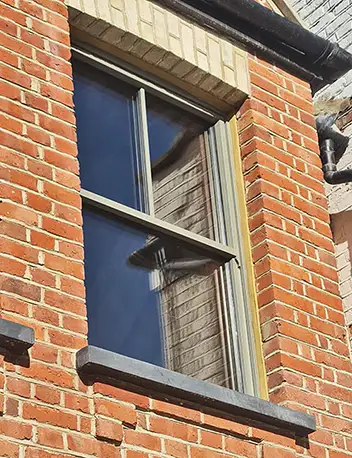
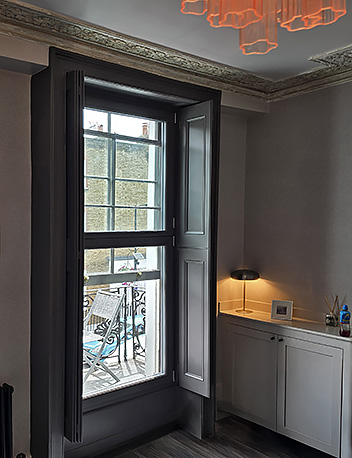
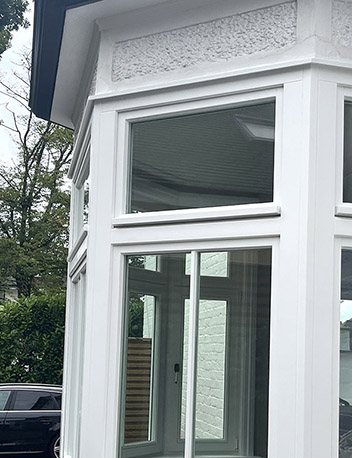
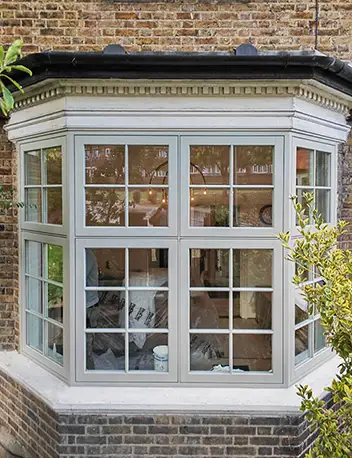
SEE OUR ACOUSTIC WINDOW SYSTEMS
WHY GLASS ALONE DOES NOT DETERMINE THE RESULT
A window is an acoustic system, not a sheet of glass in isolation. Once the glazing is improved, another part of the opening may become the limiting sound path.
Frame & seals
Opening sections need effective perimeter sealing and sufficient closing pressure. Small air leaks can materially weaken an otherwise strong glazing specification.
Installation
The perimeter between the window and the building must also be treated properly. High-rated glass cannot compensate for a poorly sealed installation joint.
The building around it
Walls, reveals, vents, roofs, floors, chimneys, adjoining façades and doors may all transmit sound. Improving the window can make one of these other paths more noticeable.
CAN ACOUSTIC GLASS BE FITTED INTO EXISTING WINDOWS?
Sometimes. Replacing only the glass can be sensible where the existing frame is already strong, reasonably airtight and capable of accepting the thicker or heavier glazing unit.
- Weight: can the hinges, sash balances, pulleys and frame sections carry the proposed unit?
- Glazing depth: is there enough rebate and bead depth?
- Airtightness: are gaps around opening sections or meeting rails already the dominant weakness?
- Hardware: can the window generate consistent compression on the seals?
- The real weak point: is the glass actually what is limiting performance?
A glass-only upgrade cannot correct a weak frame, poor seals or an uncontrolled ventilation path. In those cases, a complete replacement window or a separate secondary glazing system may be the more effective route.
GLASS-ONLY UPGRADE, REPLACEMENT WINDOW OR SECONDARY GLAZING?
| Option | What it changes | Where it can help | Main limitation |
|---|---|---|---|
| Replace the glass only | Glazing performance | Existing frame is strong, airtight and suitable for heavier/thicker glass | Does not correct weak frames, seals or installation |
| Replace the complete window | Glass, frame, seals, locking and installation | Existing window itself is a major acoustic weakness | Higher cost and potentially greater architectural/planning implications |
| Add a secondary window | A second complete internal system and larger overall separation | Strong external noise, retained primary windows and heritage constraints | Requires internal space and careful design of both systems |
For period sash windows where the original window is to remain, see our timber acoustic secondary glazing.
DOES ACOUSTIC GLAZING WORK FOR TRAFFIC, AIRCRAFT AND RAILWAY NOISE?
Acoustic glazing can be useful against all of these sources where the window is an important transmission path. The specification should still respond to the frequency content of the source and to the building around the window.
Road traffic
Buses, lorries and acceleration can contain substantial lower-frequency energy, so Ctr and frequency-band behaviour can matter as much as the headline Rw.
Aircraft
Aircraft noise varies by aircraft, operation and building. Roofs and ventilation paths can become important once the windows are improved.
Railway
Railway noise can combine airborne sound with lower-frequency energy and, in some properties, structure-borne vibration. Glazing only changes the airborne component entering through the opening.
THERMAL PERFORMANCE, SAFETY AND SECURITY
Thermal performance
Acoustic and thermal performance use some of the same components, but they are different measurements. An acoustic insulating glass unit can also deliver strong thermal performance when coatings, gas fill and cavity design are selected appropriately.
Check Rw and Ug independently. The glazing with the best Ug is not automatically the glazing with the best acoustic performance.
Safety and security
Laminated construction can provide safety and security benefits because the interlayer can help retain fragments after breakage. The actual classification depends on the exact laminate construction.
An acoustic interlayer should not automatically be treated as proof that a pane meets a particular safety or security standard.
HOW MUCH DOES ACOUSTIC GLAZING COST?
Acoustic glazing normally costs more than standard glazing because the units can use heavier panes, specialist laminates and more complex constructions. The meaningful cost question is whether the existing window can accept that glass and whether a glass-only upgrade addresses the actual weak point.
If the frame, seals or installation also need changing, the project becomes a complete-window specification rather than simply a glass replacement.
HOW WE SPECIFY ACOUSTIC GLAZING
We do not normally begin with “use the highest Rw available”. We begin with the problem.
- What is the noise source?
- Which frequencies are important?
- Is the existing window leaking air?
- Is the glass actually the weakest element?
- What frame and opening style are involved?
- How much glazing weight can the system support?
- What cavity is available?
- Is background ventilation required?
- Are there heritage or architectural constraints?
- What other sound paths may become important after the window is improved?
For straightforward projects, photographs, approximate dimensions and information about the noise source may be enough to identify sensible options for an initial estimate. Where the situation is less clear, a site acoustic assessment can help establish what is worth improving before the final specification is fixed.
TECHNICAL SOURCES AND EVIDENCE
This page distinguishes between calculated glazing performance, declared or laboratory glazing performance, complete-window testing and real-property measurements.
- Saint-Gobain Glass — Calumen calculations and insulating-glass declarations held in our technical archive.
- Guardian Glass — technical information on acoustic glass and acoustic laminated glazing.
- Pilkington — technical guidance on Optiphon and noise-control glazing.
- Glass and Glazing Federation — guidance on glazing and noise reduction in homes.
Evidence limitation: no laboratory glazing rating or complete-window rating should be interpreted as a guaranteed room-level reduction. Installed performance depends on the complete opening and the surrounding building.
ACOUSTIC GLAZING FAQs
Short answers to the questions homeowners most often ask when comparing acoustic glass, standard double glazing and complete acoustic windows.
What is the difference between acoustic glazing and standard double glazing?
Standard double glazing is normally designed primarily around thermal performance. Acoustic glazing is deliberately configured for sound insulation, using variables such as pane mass, different pane thicknesses, acoustic laminated glass and the cavity between panes. Both may be double-glazed units, but their glass build-ups and acoustic ratings can be very different. The frame, seals and installation still affect the performance of the complete window.
Is acoustic glass worth it?
It can be, where sound is entering mainly through the windows and the glazing specification is matched to the noise source. It is less useful to spend heavily on acoustic glass if the existing frame leaks air, ventilation is the dominant sound path or the surrounding building is limiting the result. The value therefore depends on identifying the actual weak point before specifying the glass.
Can acoustic glass be fitted into existing double-glazed windows?
Sometimes. The existing frame needs enough glazing depth and must be capable of carrying the additional glass weight. Its seals, hardware and closing pressure also need to be good enough for the stronger glazing to be worthwhile. Where the frame itself is the acoustic weakness, replacing only the glass can have a limited benefit.
Is acoustic double glazing better than triple glazing for noise?
Not automatically, and neither is triple glazing automatically better. Acoustic performance depends on the complete build-up: glass mass, acoustic damping, pane asymmetry, cavity widths and the resulting frequency response. A well-designed acoustic double-glazed unit can outperform a standard or poorly optimised triple unit, while an engineered acoustic triple-glazed unit can also achieve very high performance. Compare verified constructions rather than pane count.
How much noise can acoustic glazing reduce?
There is no single reduction figure that applies to every property. Glazing units can have laboratory, declared or calculated Rw values, but that rating is not the same as the reduction measured inside a room. The final result also depends on the complete window, installation, ventilation and other sound paths through the building. For this reason we do not convert a glazing Rw directly into a promised room-level reduction.
How much does acoustic glazing cost?
Acoustic glazing normally costs more than standard glazing because it can use heavier panes, acoustic laminates and more complex unit constructions. The final project cost also depends on whether the existing frame can accept the glass or whether the complete window needs replacing. For current product pricing, see our soundproof window pricing page rather than relying on a generic cost-per-square-metre figure.
DISCUSS YOUR WINDOW AND NOISE PROBLEM
Send us photographs of the existing windows, approximate dimensions and a short description of the noise source. We can advise which window or glazing approaches are worth considering before you commit to a detailed survey or specification.
NEXT STEP
Not sure whether you need replacement windows, secondary glazing or a glass-only upgrade?